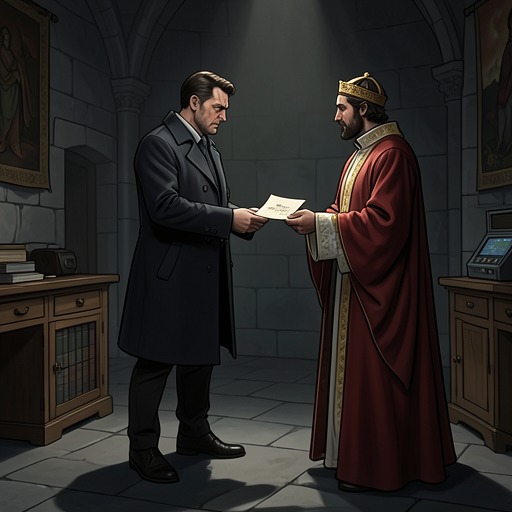
Southampton Conspiracy
Henry VThe Southampton Conspiracy is a French-backed treason plot against King Henry V, disclosed as he prepares to sail for France and brought to a decisive end when he turns the conspirators over to the law. Its dramatic force lies in the collision between private betrayal and public duty: men connected to the king’s own circle have aligned themselves with an enemy, and the monarch must answer that treachery as both its personal target and guardian of the kingdom.
Disclosure and Stakes
The Chorus identifies the conspirators as Richard Earl of Cambridge, Henry Lord Scroop of Masham, and Sir Thomas Grey, describing France as having found in them a nest of hollow loyalties. The plot is not merely dissent or disaffection: they have confirmed a conspiracy with France and accepted French payment, rendered in the Chorus’s bitter phrase as the “gilt of France.” The image of “treacherous crowns” makes the bargain seem at once financial and political, a foreign reward bound to an assault on the king’s authority.
The intended victim is King Henry V himself. The Chorus says that, if hell and treason keep their promises, the king will die by the conspirators’ hands before he takes ship for France. The intended attack is therefore fixed to a specific moment and place: before the king’s departure, in Southampton. The disclosure makes the voyage more than a military undertaking. Before the campaign against France can begin, the king faces a threat from within his own ranks and must establish that the expedition’s authority has not already been fatally compromised at home.
By announcing the danger before the confrontation, the Chorus gives the audience knowledge that the king’s apparent trust in his companions cannot safely survive. The later scene converts that foreknowledge into a public reckoning. The conspirators are not anonymous enemies arriving from abroad; their rank and proximity to the king make the betrayal an internal rupture, even as their French connection places it within the wider conflict between England and France.
Exposure and the King’s Response
King Henry V addresses the accused as men whose former closeness makes their treachery especially painful. He recalls how readily his love had once accorded with Richard Earl of Cambridge and presents their revolt as a profound fall from the loyalty expected of noble subjects. His language turns the betrayal into an inversion of the natural bond between ruler and follower: those who should stand with their master have turned against him.
The king does not allow that injury to become a warrant for private revenge. He orders the conspirators arrested and required to answer to the law. The command shifts the scene from the king’s discovery of personal betrayal to the exercise of public justice. The accused are exposed before the assembled princes and peers as examples of what the Chorus had already called corrupted allegiance, but their fate is placed under legal authority rather than left to an impulsive act of royal anger.
Sentence, Mercy, and Law
When the sentence is delivered, King Henry V invokes divine mercy while acknowledging the gravity of the offense. He tells the conspirators that they have conspired against his royal person and joined themselves to a proclaimed enemy. Sir Thomas Grey distinguishes his fault from his body in asking for pardon; the king responds with a prayer that God may acquit him in mercy, then proceeds to pronounce judgment. The exchange holds repentance and punishment together without confusing them: the request may be heard, but it does not erase the offense or prevent the sentence.
King Henry V explains that the kingdom’s safety must be treated with care because the conspirators sought its ruin. He therefore delivers them to its laws and sends them to their deaths. The sentence makes the stakes broader than the intended killing of one man. The plot threatens the security of the kingdom at the moment its king is preparing to lead an army abroad, and the response presents the law as the means by which that danger is answered. Divine mercy remains part of the language of judgment, but it does not become a reprieve.
Dramatic and Political Significance
The episode places a test of kingship before the French campaign: King Henry V must respond to an attack on his person without reducing government to personal retaliation. His grief at the betrayal is visible in the contrast between remembered affection and present revolt, while his decision to submit the accused to law establishes a boundary between wounded feeling and public authority. The king is both the intended victim and the official responsible for protecting the realm; the scene makes those roles press against one another.
The Southampton setting and the threat to the king’s departure also give the conspiracy a threshold quality. The projected voyage to France cannot proceed as if the danger were only external. Before the war’s action begins, the plot exposes a failure of loyalty within the English party and forces its removal through judgment. The conspirators’ deaths close that immediate threat, while the episode leaves the king’s campaign framed by questions of justice, sovereignty, and the cost of defending a kingdom against enemies abroad and betrayal at home.